Tuesday, March 30, 2010

PM's NEM Speech Laudable. Now Arrest Ibrahim Ali And Whip Civil Service Into Action

Prime Minister Datuk Seri Najib Tun Razak launched the New Economic Model just now. On paper it is a courageous move. “We can’t afford to duck the issues any longer. If we are to truly tackle inequality and become a beacon of progress in the region, we must create a sense of urgency to reform,” Najib had said sounding like a true statesman.

However Reuters reported that 'Najib barely touched on the raft of economic and social privileges intended for the majority Malay residents that critics say has engendered graft. The prime minister is reliant on the 55 per cent Malay population for votes'. And THAT is the crux of the whole bloody problem. Espousing lofty principles and 'unveiling' plans for radical reforms is one thing but to get it implemented is a totally different kettle of ikan bilis.

Assuming if Najib truly believes in what he is preaching (and that's a big IF) and that he has the balls to demand its implementation, there are some real obstacles in taking that path. First we have that most opportunistic, racist bastard by the name of Ibrahim Ali and his fellow low life in Perkasa who represent the ideal amalgamation of the worst qualities in Malaysian politics coupled with a deeply rooted inferiority complex. Cheering them on are the biggest dangers to national and inter-ethnic unity - Tun Dr Mahathir and DPM Muhyiddin Yassin. The latter two are above the law in Umno's Malaysia and therefore untouchable. However if there is even an iota of genuineness in Najib's reform plans he should throw the book at Ibrahim Ali and incarcerate the bastard. This should not too difficult for Najib since he has some experience in such matters. At least it would have a calming effect on non-Malay businessmen and foreign investors. Screaming racist invectives is not going to help attract FDIs.

Another big hurdle the PM would face is the equally racist and notoriously moribund civil service. Getting these indolent louts to do his bidding might prove very, very difficult for there are many Ibrahim Alis who are comfortably perched in strategic positions who will not budge unless prodded like cattle.

Then there are the rent addicted umnoputeras who will make life hell for Najib. Free largesse is more potent than drugs and the PM can expect the mother of all withdrawal symptoms to afflict a large portion of Umno's membership. Outrage, violence and cardiac arrests may ensue.

In conclusion, Najib is going to have a terrible time in the near future if he is really determined to reform the nation's outdated and racist policies. But I have grave doubts if he will even get to first base before retreating with his tail between his legs. It takes a great leader to dare bring profound changes in the face of very strong opposition even from his own supporters. The current U.S. president is one such person. And believe you me, Najib is no Barack Obama.

Labels: , , , , , , ,

Monday, July 21, 2008

Malaysia Inflation Rate May Have Reached 26-Year High

Malaysia's inflation rate may have reached a 26-year high after the government raised fuel prices, adding pressure on the nation's central bank to raise interest rates this week.

Consumer prices may climb 7 percent "or even higher'' this month after a similar gain in June, Second Finance Minister Nor Mohamed Yakcop said today in Kuala Lumpur. That would be the fastest pace since January 1982, according to Malaysia's statistics department.

Neighboring Thailand and Indonesia have raised borrowing costs to offset the effect of soaring oil and food prices. A 41 percent increase in gasoline prices in June has kick-started price gains in Malaysia, where the central bank has kept its key interest rate unchanged since April 2006 to boost growth.

A "monetary policy response will be needed to set inflation expectations on the right course,'' said Irvin Seah, an economist at DBS Bank Ltd. in Singapore. The situation is "clearly beyond the comfort zone of the central bank.''

Bank Negara Malaysia is due to announce its monetary policy decision in Kuala Lumpur on July 25. The overnight policy rate is currently 3.5 percent.

Still, price increases for this month and in June may be "one-off'' gains, Nor told reporters. Inflation for the year won't be more than 5 percent, he said.

"There's no reason to believe it will be repeated in following years,'' Nor said.

The minister said Malaysia's economic growth for 2008 should be about 5 percent, at the lower end of a 5 percent-to-6 percent range given by the central bank in March. (Bloomberg.com)
Image - Source

Labels: , ,

Sunday, July 06, 2008

Thousands Of Protestors Throng Kelana Jaya Stadium

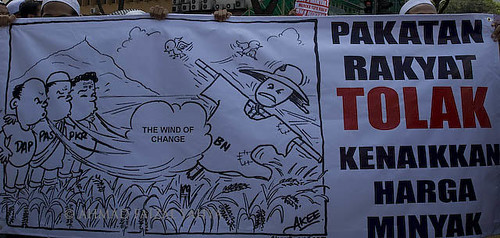
Thousands of protestors, led by several NGOs and Pakatan Rakyat leaders, have thronged the Kelana Jaya stadium here to protest against the fuel hike.

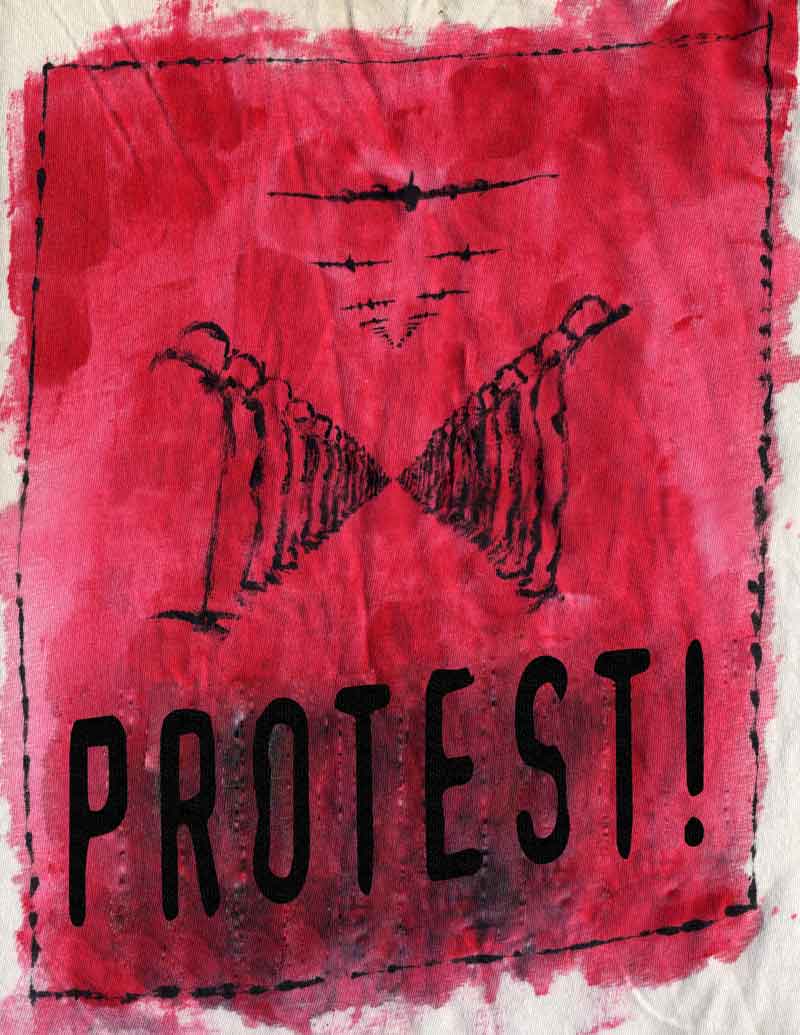
Many of them were wearing red shirts, emblazoned with the word "protest" to voice their dissent.

Despite the crowd, estimated at between 15,000 and 20,000, there was no heavy police presence. Only a few patrol cars were seen monitoring the area.

The carnival like atmosphere also saw various traders cashing in on food and drinks, T-shirts and souvenirs.

Several PKR and Hindraf leaders also rallied the crowd with speeches and shouts of Reformasi! and Minyak turun!.

The crowd had been increasing since about 10am. Among those expected to speak at the rally include PAS spiritual leader Datuk Nik Aziz Nik Mat , vice president Mohamad Sabu, DAP adviser Lim Kit Siang and PKR de facto leader Datuk Seri Anwar Ibrahim. (The Star Update)
Image - Source

Earlier report: Malaysian Fuel Price Hike Protesters Vow To Go Ahead Despite Police Warning

Labels: , , , ,

Friday, July 04, 2008

Malaysian Fuel Price Hike Protesters Vow To Go Ahead Despite Police Warning

Malaysia's opposition-backed protesters vowed today to go ahead with a mass rally against a steep hike in fuel prices, despite a police warning that it was illegal.

The hard-line stance raised fears of clashes during the rally scheduled for Sunday amid a politically charged atmosphere.

Hatta Ramli, a protest leader and senior official in the opposition Pan-Malaysian Islamic Party, said police have been informed of the rally in central Selangor state.

But protest organizers do not plan to apply for a police permit, required in Malaysia for gatherings of more than four people, he said, urging police not to aggravate the public by breaking up the gathering. In the past, police have ended rallies with tear gas, water cannons and mass arrests.

"All along we have been organizing gatherings as part of the right of citizens to assemble. ... It is always peaceful," he said.

To calm fears of disturbances, activists moved the rally from a sports field to a stadium, said Yap Swee Seng, a human rights activist and protest leader. "It's basically for security reasons ... to avoid provocation," Yap said, adding organizers were afraid the rally could be infiltrated by people wanting to cause trouble.

Activists hope up to 1 million people will attend the all-day event with stage shows and speeches by opposition politicians, including opposition leader Anwar Ibrahim, Hatta said.

But Yap said "fear and anxiety" about possible trouble may cause people to stay away.

Selangor police chief Khalid Abu Bakar warned the public to avoid the gathering, saying police would "take the appropriate action. I still call on the public not to attend the rally. It is an illegal rally," Khalid said without elaborating on what measures police would take.

Public anger against the federal government, run by the National Front party, is already high after gasoline prices were increased by 41 percent and diesel prices by 63 percent last month. Food prices have also been rising.

The country's tense political climate since March general elections — when the opposition made unprecedented gains against the National Front — heated up further last week when Anwar was accused of sodomy by one of his aides.

Anwar has dismissed the allegations as a conspiracy by political opponents.

Police detained two opposition activists outside a Kuala Lumpur mosque Friday while they were handing out pamphlets in an attempt to disprove the allegations against Anwar, said opposition representative Shamsul Iskandar Mohamad Akin.

District police contacted by phone declined to comment.

Anwar, a former deputy prime minister, was jailed on a sodomy and corruption conviction a decade ago. The sodomy conviction was later overturned and Anwar was released from prison in 2004. (International Herald Tribune)

*****
It looks like the already heated political situation is going to spill over to the weekend too. The cops for one will be having their hands full, while politicians, NGOs and others 'battle' it out. For those who don't intend to take part in the above gathering, stay cool and keep far away from the venue.
Image - Source

Labels: , , , ,

Friday, June 27, 2008

Oil Jumps To New Record Near $142 A Barrel!

Oil leapt to a new record high near $142 a barrel on Friday, extending gains after surging nearly 4 percent in the previous session, as tumbling global stock markets triggered a wider commodities rally.

U.S. light crude for August delivery was $1.71 up at $141.35 a barrel by 5:25 a.m. EDT, off highs of $141.71. London Brent crude was $1.56 up at $141.39, off highs of $141.98.

World stocks fell to a three-month low as a fast deteriorating global inflation picture fanned concerns over the outlook for corporate profits, hastening the rush of investors' funds into commodities.

"It has a lot to do with asset allocations. The equity markets are under serious pressure, breaking support levels. When equities are going nowhere, the money is parked into commodities," said Olivier Jakob at Petromatrix.

The MSCI main world equity index fell more than 0.6 percent to its lowest since March, with the index on track for the worst monthly performance in percentage terms since September 2002, according to Reuters data.

By contrast, commodities fared better, with gold steady near a one-month record high while U.S. corn futures jumped to a fresh record high.

CURB SPECULATION


Oil's latest surge comes despite moves in the U.S. to curb energy market speculation.

U.S. lawmakers on Thursday have approved legislation which directs the Commodity Futures Trading Commission (CFTC), the futures market regulator, to use all its authority including emergency powers to "curb immediately" the role of excessive speculation in energy futures markets.

Oil prices have doubled from $70 a year ago on supply disruptions and geopolitical tensions in the Middle East. Rising flows of cash into commodities from investors seeking to hedge against inflation and the weak dollar have also added to gains.

"It may be months away before the legislation comes into effect but just the fact that it was passed is definitely enough to give the market a little bit of a bearish sentiment," said Toby Hassall, analyst at Commodities Warrants Australia.

Oil, which had been trading in a range for most of the week, broke out of that range after Libya said it was studying possible options to cut output in response to potential U.S. actions against OPEC countries.

"We are studying all the options," Libya's most senior oil official, Shokri Ghanem, told Reuters, adding oil producers needed protection from what he viewed as U.S. attempts to extend its jurisdiction beyond its territory.

OPEC President Chakib Khelil's comments that prices could reach $170 a barrel in the coming months, also fuelled the rally. "I forecast prices probably between $150 and $170 during this summer. That will perhaps ease towards the end of the year," he told France 24 television.

Talks between oil workers and Chevron continued in Nigeria, with the oil minister saying he was confident a deal could be reached, but union officials left open the possibility of a strike early next week. (Reuters)

***** If like dis, die lah brudder!
Image - Source

Labels: ,

Saturday, June 21, 2008

Price Of Paper, Stationery, Printing & Packaging Go Up By 10% - 40%! The Greed Merchants Have Started Their Plunder

The price of paper, stationery, printing and packaging products will go up by 10% to 40% starting Sunday, and possibly by 50% by the end of the year.

The Malaysia Paper Merchants Association, Selangor & Federal Territory Chinese Printing Presses' Association, Malaysia Printers Association and the Selangor & Kuala Lumpur Stationers & Booksellers Association jointly announced the increase on Saturday.

Selangor & Federal Territory Chinese Printing Presses' Association secretary Alexander Lee told reporters at a press conference that the price hike was inevitable.

"There has been a tremendous increase in the global price of raw materials, especially pulp.

"The industry has tried to absorb the global raw material price surge without increasing product prices, but it cannot sustain this anymore," he said. (The Star)

***** These buggers had been waiting for an opportune time to screw the nation and now with the fuel price hike and with the government more concerned about trying to stay in power than worry about rising prices, these greed merchants have struck this weekend. This is just the beginning. Let us await the thousands of other avaricious bastards who feed off our economy and are now eagerly standing in line to take their turn at right royally pillaging us. I wonder what Shahrir Samad has to say about this?
Image - Source

Labels: , , , , ,

Tuesday, June 17, 2008

Petronas Accounts - For Once I Agree With Khairy

Petronas should publish a more detailed financial statement and then table it in Parliament so that there is greater transparency, said Rembau MP and deputy Umno youth chief Khairy Jamaluddin.

“The call that I made for Petronas to disclose its financial statement goes above and beyond the annual report that is published on its website. I believe most MPs are aware of Petronas’ published financial accounts.

"However, the annual report only highlights a summary of Petronas’ financial position without going into any detail.

"While I appreciate that the standard of the annual report surpasses the requirements of the Companies Commission of Malaysia, I think it is also fair to say that Petronas is not an ordinary corporation," he said in a statement.

He was responding to a report in The Star on Tuesday quoting Petronas acting chairman, president and chief executive officer Tan Sri Mohd Hassan Marican as saying that the corporation’s account had been published and made public for the past 18 years. Hassan said 5,000 copies of the report was printed and distributed to various quarters and it was also available on Petronas' website.

Khairy said Petronas had been tasked with safeguarding the nation’s most important natural resource on behalf of the people and, "therefore, should be held to a higher level of scrutiny.

He claimed that the summarised financial figures found in Petronas’s annual report did not meet this higher level of scrutiny.

"I would suggest that Petronas commits itself to greater transparency and accountability by agreeing to give a special briefing to all MPs on the company’s corporate activities and financial position, and open the briefing to questions from the floor.

"This would provide the MPs, and therefore the public at large, with a more meaningful insight into Petronas apart from the financial summaries that are currently available to the public,” Khairy added.

In Penang, Chief Minister and DAP secretary-general Lim Guan Eng said Petronas should give details on how it spends its earnings, including money used for purchases of planes.

He said Petronas should explain to the people how it spent money on sponsorship programmes and charity as well as reveal the number of luxury cars and jets it owns.

“The online annual report is insufficient as we need to know more than the number of oil barrels Petronas produced in a day,” he said after opening Axon’s new Penang office here on Tuesday.

“In hard economic times, we expect Petronas to play a role in easing the burden on the people,” he said. (The Star)

*****
Petronas acting chairman, president and chief executive officer Tan Sri Mohd Hassan Marican thought he could bullshit his way out of this situation by saying that the corporation’s account 'had been published and made public'. But alas there seems to be much, much more to the story than what he's letting on. Hopefully over the next few days we can get to see some real, unedited figures which will tell their own sordid tales of avarice and abuse of power.
Image - Source

Labels: , , ,

Monday, June 16, 2008

Petronas To Open Its Ledgers To The Public?

Malaysia's state oil company Petronas will open its books to the public after a decision to hike fuel prices by more than 40 percent set off days of protests, news reports said on Monday.

The reports come with a major opposition party still calling for as many as 100,000 people to take to the streets at a rally early next month amid growing anger over the cost of fuel in Malaysia, which is heavily state subsidised.

Nor Mohammed Yakcop, the country's second finance minister, told the New Straits Times newspaper that Petronas could open its ledgers to the public as soon as next week as the government looks at cutting the fuel subsidy.

"As a government that is entrusted by the people, we have to make sure our revenues are spent prudently," he said.

The government has forecast that unless subsidies are restructured, it will spend around 10 billion ringgit (3.1 billion dollars) in the second half of 2008 in the face of a global surge in oil prices .

But Nor Mohammed brushed off calls to use the Petronas revenues to finance the subsidy. "We can't simply spend all our revenue on the people of this generation," he said. "What will happen to our children in the next generation and beyond?"

Malaysia hiked its fuel price by 41 percent earlier this month, which raised the price of petrol to 2.70 ringgit (84 cents) per litre.

Opposition groups welcomed the news that Petronas would show how it has spent its money. "The time has come for the full accounting of its stewardship of the country's oil billions," said Lim Kit Siang from the Democratic Action Party. There should be a full explanation with regards to the management of the funds, with nothing hidden from the public," he told AFP.

***** Whether there will be full disclosure or a distilled, abridged version for public consumption remains to be seen. Perhaps Dr Mahathir might come out screaming tomorrow that this is yet another ploy to 'shut him up' from speaking out. If hypothetically Petronas should release a true and verifiable record of its accounts, then apart from Pak Lah, Dr M too will have his hands full answering a lot of inconvenient questions on their roles in the manipulation of the Petronas billions.
Image - Source

Labels: , , ,

Sunday, June 15, 2008

Iskandar Malaysia Development Can Cause Malays To Be Sidelined, Says Dr Mahathir

Former Prime Minister Tun Dr Mahathir Mohamad again charged that the development of Iskandar Malaysia in south Johor bordering Singapore, would not only turn the 2,217sq km area into 'Singapore North' but could also cause Malays in Johor to be sidelined.

"The residents there will be quite rich and they will be from Singapore. In the end, there will no be more Malays there because they will not be able to buy land (due to high prices) and when the outsiders are too many, they will start asking for this and that right," Dr Mahathir said in a dialogue session here Saturday.

In that regard, he reminded Malays in the development corridor to not easily sell their land when offered very high prices by certain quarters.

The corridor that was also known as the South Johor Economic Region (SJER) was announced by Prime Minister Datuk Seri Abdullah Ahmad Badawi on July 30, 2006.

Its name was changed to Iskandar Development Region on Nov 4, 2006 in line with the name of the Sultan of Johor, Sultan Iskandar, before it was again changed to Iskandar Malaysia on April 11 this year.

More than RM47 billion is needed to develop the area as the largest growth centre in the region until 2025.

The total development area is said to be about 2 1/2 times the size of Singapore when fully completed with Khazanah Nasional Berhad as the primary driver of this development vision. (Bernama)

***** Dr Mahathir is increasingly becoming synonymous with scaremongering, a devious tactic he had not only mastered but had used to perfection during his twenty-plus-year rule of the country. But that cunning strategy will not pay him dividends at this point in time although he so desperately hopes it would. And to that end he is prepared to use every dirty trick in the book to get his way.

Labels: , , , ,

Saturday, June 14, 2008

Don't Politicise Oil Price Hike Says Home Minister Syed Hamid

Home Minister Datuk Seri Syed Hamid Albar slammed the Opposition for politicising the fuel price hike issue and said protests will not solve any problems.

"The price increase of crude oil is a global phenomenon. We did not raise the price just because we felt like it. We do not like the high price too," he said.

He was speaking to reporters Saturday after opening the police family day here.

Syed Hamid was asked to comment on Friday's protest in Kuala Lumpur over the increase in fuel prices.

"It does not solve anything. In fact, it causes more problems such as traffic congestion and affects businesses around the area," he said.

He added that the police practised a high level of tolerance during Friday's demonstration and did not engage the crowd.

On Friday, a large group led by PAS Youth chief Salahuddin Ayub gathered in front of the Kampung Baru mosque after Friday prayers to protest against the recent fuel price hike.

Syed Hamid stressed that the organisers should ask for permission from the Home Ministry first before holding demonstrations.

"If they want to do it in a contained area, we will consider it.

"I cannot say yes, I cannot say no (whether to approve or not), but I will look at the application," he said.

***** Syed Hamid said that
the ''police practised a high level of tolerance during Friday's demonstration and did not engage the crowd'. How come the cops didn't show the same restraint at a gathering of Indians at Istana Negara this morning?

I suppose it would have been politically suicidal for an already weakened government to unleash the thugs in the police force on Muslim Malays and that too after Friday prayers. Indians however seem to be fair game all year round. Some things won't change.

Labels: , , , ,

Friday, June 13, 2008

Raising Fuel Prices An Inevitable Move, Says Pak Lah

Prime Minister Datuk Seri Abdullah Ahmad Badawi said today he hoped the people would understand that the government's move to raise fuel prices recently was inevitable.

He said the government had to up the price of petrol by 78 sen to RM2.70 per litre and the price of diesel by RM1 to RM2.58 per litre on June 5 though it was never its intention to burden the people.

"The price of crude oil in the global market is continuing to rise and the government has been forced to increase its fuel subsidy," he said when addressing community leaders and senior government officers at a lunch in conjunction with his one-day visit to Kelantan today.

The prime minister said that though the government had to continue subsidising the rising fuel prices, it would not raise them again this year.

"We understand the problem faced by the people and are doing everything possible to ensure that the recent increase in fuel prices will not further burden them, and we give the assurance that the fuel prices will not be raised again (until the end of this year)," he said.

He said he would elaborate on the issue of higher fuel prices at his meeting with the people scheduled for tonight at the Kelantan Poverty Foundation in Padang Kala here. (Bernama)

***** Pak Lah - between the devil and the deep blue sea.

Labels: , , ,

Government Says It Will Clamp Down On Today's Fuel Hike Protest

Malaysian authorities vowed to stop an opposition rally on Friday against a sharp fuel price rise that has stoked public anger and handed a poltical weapon to Prime Minister Ahmad Abdullah Badawi's rivals.

Protests have so far been small and scattered, but on Friday after Muslim prayers, the opposition plans to draw 20,000 people in a march from a mosque in a poor part of Kuala Lumpur to the iconic Petronas towers in the city centre to underline anger against the state energy giant.

Police have urged people not to join the rally, termed illegal because no permit has been issued, and warned they would arrest protest leaders.

"Demonstrations and illegal assemblies only disrupt public order and cause traffic chaos," the pro-government New Straits Times quoted city police chief Muhammad Sabtu Osman as saying. We are not sure how many protesters will turn up and which routes they will take. But we are taking all precautionary measures," a police spokesman told Reuters.

There are tight restrictions on public gatherings in Malaysia, but the opposition has said it will go ahead anyway.

"The people are angry. They say the fuel price is very high so they want to say something," said Safarizal Saleh, a leader of the youth wing of the Parti Islam SeMalaysia (PAS), the main Islamist party and one of the organisers of the rally.

Petrol prices were raised by 41 percent and diesel 63 percent in line with a global surge in oil prices, a measure that would drive inflation to a 10-year high of 4.2 percent in 2008.

The government says it will save 13.7 billion ringgit ($4.2 billion) as part of a broad overhaul of its heavily subsided energy pricing system.

Trying to assuage public anger, Prime Minister Ahmad Abdullah Badawi has said there will not be any more fuel increases this year and announced a cut in the allowances of ministers as part of measures to cut government costs.

Despite the rises, pump prices for petrol in Malaysia are still among the cheapest in Asia.

But critics led by former deputy prime minister Anwar Ibrahim have rejected the measures as too little and questioned why Malaysia, the largest net oil exporter in Asia, should face the fuel hike when the country earns 250 million ringgit ($76.76 million) a year in revenue for every $1 rise in crude prices.

"Although Petronas is estimated to have earned RM2trillion over the last 34 years ... its accounts are not accessible to (the) public nor by the people's elected representative in Parliament," said Waytha Moorthy, chairman of HINDRAF, a group campaigning for the rights of ethnic Indians which is supporting the fuel protests.

Petronas posted a record profit of $12.9 billion for the year ended March 31 2007, helped by a boom in crude oil prices. The state oil firm is expected to release its 2008 earnings at the end of June.

***** Petronas' earnings over the years have been siphoned off by various government 'policies' and we can forget about getting even an estimate of where it all ended up. When the government can't even give us a proper accounting of the KL Commonwealth Games expenses do you think they'll budge on the Petronas billions?

Labels: , , , ,

Monday, June 09, 2008

Anwar Ibrahim Seeks Government Ouster Over Fuel Hike

Thousands of Malaysians on Sunday took part in the biggest opposition protest against a sharp rise in fuel prices that has stoked public anger in the oil exporting country.

The rally in a football ground in the capital by opposition figurehead Anwar Ibrahim was part of a series planned to pile pressure on beleaguered Prime Minister Abdullah Ahmad Badawi to either reconsider the oil and diesel price rise or resign.

"Reformasi, reformasi", the crowd in a poor, largely ethnic Malay part of Kuala Lumpur shouted, recalling Anwar's rallying call for reforms from a 1998 campaign after he was sacked as deputy prime minister.

"Politically, the message was clear on March 8, economically it's now a disaster. That is why we are calling on them to resign," Anwar said at the late night rally.

Abdullah, fighting for political survival after leading his coalition to its worst electoral performance in five decades of rule in March, has said the price rise was necessary in line with a global surge in oil prices.

Fuel subsidies have become financially crippling, the government said. Pump prices in Malaysia are still one of the cheapest in Asia.

But Anwar said the decision to raise petrol prices by 41 percent and 63 percent for diesel will hasten the government's fall as members of the ruling coalition begin to break ranks over the move that would drive inflation to a 10-year high.

Anwar has said he has enough lawmakers to topple the government following the March 8 election and was waiting for the right moment. Anwar said in the past three months alone his party had received 50,000 applications for membership and these included members of constituent parties of the ruling coalition.

"We have seen clearly more interest and support for Pakatan Rakyat (the opposition alliance). This applies even to members of parliament. Even some of them have been encouraged to approach me directly even though they are being closely monitored," he said.

But he did not give any details and analysts say Anwar, who was cast into the political wilderness after being dumped in 1998 by his former mentor, ex-prime minister Mahathir Mohamad, has repeatedly made claims without showing any evidence.

PROTESTS

Protests in Malaysia, unlike in countries such as India and Indonesia which too have raised fuel prices, have been small and scattered, partly because of restrictions on public assembly.

But the opposition has planned a demonstration on July 12 when it says it will bring 100,000 people into the city centre to demand that fuel prices be restored to earlier levels.

The government has said it would save 13.7 billion ringgit ($4.23 billion) as part of a broad overhaul of its heavily subsidised energy price system. The money used for subsidies, which eats up a third of the budget, would be better spent on development projects, the government said.

Abdullah, also fighting to fend off a challenge to his leadership from within, will spell out measures this week to ease the burden on consumers, state media said. The proposals include ways for state bodies to save costs, widen the social safety net for the poor, increase the number of price-controlled items and improve public transport.

***** What strategy has the opposition to control fuel prices here amidst an unprecedented and devastating surge in the selling price of crude oil? These protests seem more like rank opportunism and cashing in on the misery of the average Joe. The dilemma that we face now is not of the government's making. It is merely responding to the economic situation and while we have no choice but to bite the bullet, the kerajaan is at least trying to soften the blow with relief in other sectors. If this can be done speedily and efficiently then the ill-feeling all round would be somewhat assuaged.

Assembling a hundred thousand people to protest the fuel hike is not the way to go. Carefully and precisely enunciating their plan to overcome the current economic crisis is what the opposition should be doing instead of stirring unnecessary trouble at a time of stringency.

Labels: , , ,

Saturday, June 07, 2008

Fuel Price Hike 'Unconscionable', Says Anwar Ibrahim

Malaysian opposition leader Anwar Ibrahim said Friday that his government's decision to sharply raise fuel prices was "unconscionable."

In a move to end decades of heavy subsidies that have kept Malaysian fuel prices among Southeast Asia's lowest, the Malaysian government Thursday jacked up the pump price of gasoline by 41 percent to 2.70 ringgit (US$0.87) a liter, or 10.23 ringgit (US$3.30) a gallon.

Diesel prices shot up 63 percent to 2.58 ringgit (US$0.80) per liter.

Speaking at a forum in Manila, Anwar noted that Malaysia is a net exporter of petroleum, which annually generates "huge resources and profit."

"To decide summarily, without regard to the plight of the vast majority, particularly the poor and the marginalized, to me, is unconscionable," he said.

In Kuala Lumpur, Domestic Trade Minister Shahrir Samad said Friday that the government will not revise the price increases despite opposition protests, but assured there would not be further hikes anytime soon.

Like some other Asian countries, Malaysia had faced a spiraling fuel subsidy bill that could have been more than 56 billion ringgit (US$17 billion) this year due to rising world oil prices.

Anwar, a former deputy prime minister and finance minister who now leads an opposition coalition, said, "We cannot opt for any other thing except for market economy ... but this cannot be done without regard to the issues of good governance and accountability."

Anwar was fired by then-Prime Minister Mahathir Mohamad in 1998 in a power struggle. He was expelled from the ruling party and convicted of sodomy and corruption, charges he says were politically motivated.

He was released from prison in 2004 after the sodomy conviction was overturned, but the corruption conviction barred him from holding political office until April 15, 2008. (International Herald Tribune)

Labels: , , ,

Friday, June 06, 2008

Umno Seeks To Ride Out Fuel Protests

Malaysian Prime Minister Abdullah Ahmad Badawi's party was meeting on Friday hoping to weather a storm over unpopular fuel price hikes that come on top of a poor showing in elections earlier this year.

The two-day meeting of the supreme council of United Malays National Organisation was meant to set out a blueprint to revitalise the party following the election in March.

But Abdullah has come under renewed pressure from the opposition over the 41 percent rise in petrol prices and the 63 percent increase for diesel.

UMNO is the backbone of the National Front coalition which has led Malaysia since independence in 1957. Supreme council members planned to "chart the party's future and formulate strategies to regain support", Bernama said.

But analysts said this week's price rises could trigger an early exit for Abdullah. State media said he was expected to attend the meeting's closing session on Friday.

"The fuel price hike makes it more difficult for the prime minister to conduct a smooth transition of power," said Hussin Mutalib, a political scientist who tracks Southeast Asian issues at the National University of Singapore. "There could be a push forward for him to leave fast."

The fuel rise is expected to lift average inflation to a 10-year high of 4.2 percent in 2008, central bank chief Zeti Akhtar Aziz said on Thursday, compared to last year's 2 percent.

The hike comes two months after the ruling coalition recorded its worst-ever performance in a general election during its 50-year rule.

Angered by the rising cost of living and growing racial and religious conflict, Malaysians voted to hand control of five of the country's 13 states to the opposition in the poll.

There was a small protest against the fuel hike in the capital on Thursday and the opposition plans a bigger protest after Muslim prayers on Friday.

Mustapa Mansor, chairman of Ikrar, a non-governmental organisation that is made up of opposition front members, said between 100 and 200 people were expected to take part in the protest ahead of a likely bigger demonstration next month.

***** Pak Lah finds himself in a lose-lose, damned if you do, damned if you don't situation. I don't envy him. Let's wait and see how Umno extricates itself from this mess.

Labels: , , ,

Thursday, June 05, 2008

Government Over-Reacting To Global Oil Market, Says Mukhriz Mahathir

Being a net oil exporter, Malaysia should not have overly reacted to the artificially inflated global fuel price, Jerlun MP Datuk Mukhriz Mahathir said.

Instead of restructuring the country’s subsidy package according to the volatile global market price, the authorities concerned should have formulated strategies to cushion the impact, he said.

He described the petrol price increase by 78 sen per litre and diesel by RM1 per litre as too drastic.

“The rakyat is already burdened by the rising cost of living. We cannot justify the increase by saying that our fuel price is still lower than Singapore. “We cannot compare with Singapore, as their per capita income is three times higher than us,” he said, adding that the people were not prepared for the additional burden.

He appealed to Prime Minister Datuk Seri Abdullah Ahmad Badawi to look into the possibility of imposing the fuel increase on staggered basis.

“If Pak Lah is not up to it, please make way for someone who is willing to do it (impose measures that would ease public burden),” he said.

Abdullah had not taken into consideration the feelings of the rakyat when he made such a drastic decision, which had a spiralling effect on consumer goods and food.

“Although we read in papers that the economy is thriving, men on the street are not feeling it. They also do not have the means to absorb the sudden increase in fuel price,” he said.

He called on the authorities to formulate a workable solution to avert a crisis. “We can look into unconventional methods to address the problem. For example, during the Asian financial crisis, Malaysia pegged the ringgit to shield currency onslaught. During that time, we were criticised for ignoring the principles of economy. But such unconventional measure proved to have worked in our favour,” he said.

Mukhriz also criticised an article that highlighted Singaporeans expressing relief that the Malaysian government would not imposed a ban on sales of fuel to foreign-registered vehicles at petrol stations located within 50km from the border.

“It sounds ironic, as if we are doing this for the Singaporeans, not for us (locals),” he said. (The Star)

Labels: , , ,

Protesters Target Malaysian Fuel Price Hike

Malaysia's government faced demonstrations and public outrage Thursday over its decision to hike petrol prices 40 percent overnight, in a bid to curb its massive subsidies bill.

Opposition groups said they would hold protests in Kuala Lumpur at 11.30am (0330 GMT) and in the northern city of Ipoh at 11.00am over the "unconscionable" increase.

"The fuel increase is both economically inefficient and socially unjust," said Lim Guan Eng, secretary-general of the Democratic Action Party which is part of the opposition alliance.

"So long as rich companies continue to enjoy such fuel subsidies, especially the independent power producers, the fuel increase will be seen as both pro-rich and punishing the poor," he said in a statement.

The new pump price for petrol will be 2.70 ringgit (0.84 dollars) and 2.58 ringgit for diesel. Petrol previously cost 1.92 ringgit, among the cheapest in Asia.

Prime Minister Abdullah Ahmad Badawi's announcement on Wednesday evening triggered chaos across the country as motorists swamped fuel stations to fill up before the measure took effect at midnight.

Traffic snarls brought streets to a standstill in the capital Kuala Lumpur as up to 100 cars queued at each petrol station which still had fuel to sell, while many others said they had sold out and turned angry customers away.

Abdullah indicated that further increases were in the pipeline as Malaysia moves to completely abandon fuel price controls that would have cost 17.4 billion dollars this year -- about a third of the national budget.

"God willing I hope Malaysians will not demonstrate over this," he said, referring to fury over earlier hikes in a country where public transport is poor and most people are reliant on their cars.

Motorists who turned up at petrol stations Thursday to pay sharply higher prices to fill their tanks were uniformly furious over the decision.

"We can do nothing about this government increase -- we have to buy fuel, otherwise how can we go to work?" said 56-year-old engineer K. Letchumanan. "For my family it's not so bad as we have two incomes, but the poor people will suffer."

Aminah Rahmat, a 46-year-old streetside vendor who had set up her food stall outside a petrol station, said she could already barely manage on her monthly income of less than 1,000 ringgit (300 dollars). "The government does not care for our welfare, that is why they have made such a huge fuel increase," she said. "How can I afford to pay so much to transport my cooked food to my customers? I will go out of business."

Bus operators said that a third of companies may have to close down and lorry firm said their rates would have to rise, in a move that will trickle down to higher prices for goods and services.

Abdullah is taking a major political risk in removing price controls as he attempts to recover from disastrous March elections that dealt the ruling coalition its worst results in half a century. Rising prices of food and fuel were a major factor in the ballot, which has triggered repeated calls for the premier to stand down.

"It is not an attempt to be popular, we have to think in the best interests of the people," Abdullah said Wednesday.


Under a revamped subsidy system, drivers of smaller vehicles will receive a cash payment of 625 ringgit to offset the rising cost, equating to subsidising some 800 litres of fuel.

But economists said the subsidy cut was deeper than anticipated, and that the cash payment was not large enough to compensate for average use.

Abdullah said the price hike could suppress economic growth and drive up inflation as high as 5.0 percent this year, from current levels of 3.0 percent in April.

As part of the subsidy reform, industry and power producers will be charged higher prices for gas from July. Electricity tariffs will rise 18 percent for householders, and 26 percent for commercial and industrial users.

But there was good news for Thais and Singaporeans who will now be allowed to buy fuel at border petrol stations after a recent ban was lifted in view of the subsidy cut.

Labels: , , , , ,

Monday, June 02, 2008

Fuel Price May Rise Beginning August, Says Minister Shahrir

Domestic Trade and Consumer Affairs Minister Datuk Shahrir Abdul Samad today hinted that petrol and diesel prices may go up beginning August.

"It will happen...petrol prices will increase, I think the idea is in August this year when the subsidy system is re-structured," he said.

The increase in fuel prices is in line with the structuring of the new mechanism for the fuel subsidy scheme enjoyed by the people now.

"There are already several proposals and the mechanism has been submitted to the Finance Ministry and it will be decided in the best manner," he told reporters at the Parliament lobby here.

He said although the fuel price would go up, the petrol subsidy would continue to be enjoyed by the people based on requirement instead of usage.

"If we look at the subsidy that we receive today, it is based on the amount used, if we consume 200 litres per month, we will receive subsidy for each litre that we purchase. If we use only 100 litres, will will also be given the subsidy, so this means there is no restriction to the subsidy that we get based on our usage. (Bernama)

***** Be prepared to tighten your belts further, if you haven't already.

Labels: ,

Sunday, June 01, 2008

Malaysia's Grand Economic Plan Hit By Politics, Apathy

Malaysia's plan for a showpiece economic zone in its south is in doubt because of the uncertain fate of the country's prime minister and a lukewarm response from big investors in nearby Singapore.

On paper, Prime Minister Abdullah Ahmad Badawi's pet project to develop the 2,200 sq kms (850 sq miles) of land in southern Johor state into a economic zone to complement the rich but land-scarce city-state of Singapore looks good.

The area has so far drawn $10.5 billion in investment, much of it from the Middle East, riding on investor hopes the area will become a hinterland for the city-state the way that China's booming Shenzhen, once a tiny fishing village, complements neighbouring Hong Kong.

The Iskandar Malaysia zone, three times bigger than Singapore, would be Malaysia's largest economic zone. The government says it should create 800,000 jobs and attract $100 billion in investment over 25 years.

Its proponents say it could be Southeast Asia's answer to China's Pearl River delta, a manufacturing heartland that turns out more than a quarter of China's worldwide exports.

But Malaysia's track record in getting such grand projects off the ground is patchy and Singapore developers are looking to booming China and India instead, worried the plans will be shelved if Abdullah loses power.

"It's Abdullah's project. If he's not around, no one knows what's going to happen as different prime ministers will have different priorities," said Suan Teck Kin, an economist at Singapore's United Overseas Bank (UOB).

Abdullah's position weakened after the poor showing of his ruling coalition in March polls and speculation is rife he may be forced to resign.

"Given this kind of political vacuum in Malaysia, I don't think anyone will be rushing into Iskandar," said Song Seng Wun, a Singapore-based economist at Malaysian bank CIMB.

Expensive government development projects have been for years Malaysia's answer to regional economic disparities in a country spread over the Malay peninsula and parts of the island of Borneo.

Their success has been mixed at best. UOB's Suan cited a proposed IT zone near the capital Kuala Lumpur as an example of a project that is struggling after its sponsor and Abdullah's predecessor, Mahathir Mohamad, left office.

SINGAPORE WARY

State investment arm Khazanah Nasional, which has opened a marketing office in Singapore to promote the Iskandar zone, brushed off political concerns and said investors are committed to Malaysia.

Mainly Muslim Malaysia has been a magnet for Middle Eastern investors flush with petrodollars who have been snapping up banks, hotels and malls.

Abu Dhabi investment arm Mubadala Development Co is leading a consortium to develop a multi-billion dollar city within Iskandar. Kuala Lumpur has also established itself as a leading centre in Asia for the burgeoning Islamic Finance market.

But state-linked Singapore developers have been cool to Iskandar. Many analysts say for it to really take off, it needs Singapore firms such as CapitaLand to develop on land that costs as little as 1/30th of Singapore land.

"Singapore investments could be very crucial for Iskandar," said Malaysian political analyst Khoo Kay Peng. "Malaysia needs investments in high-technology areas such as biotech, rather than just a pure real estate play," he said.

Singapore developers are wary after they got burned by frequent and unexpected policy changes during Mahathir's reign, said the head of investments at one Singapore firm.

The two countries have a long history of strained relations dating back to 1963 when they gained independence from the British as a federation only to split up two years later.

At the time Singapore feared it could not survive on its own with no natural resources and squeezed into an area half the size of Greater London. But since then the island has established itself as a major Asian business and finance centre competing with Hong Kong.

However, it lacks a readily available pool of land and labour that booming southern China offers to Hong Kong, and south Malaysia's development plans aim to fill that void.

Yet rather than counting on its neighbours, Singapore has tried to overcome the lack of space by reclaiming land from the sea and shifting factories to the neighbouring Indonesian island of Batam.

Local firms in their quest for profits and growth are also looking further afield to booming economies of China, Vietnam and India. For example, a group of Singapore government-backed firms led by Keppel Corp is building an "eco-city" in China, while state firm Ascendas manages business parks in five Indian cities.

And despite Malaysian lobbying, Singapore's official response to the project did not go beyond forming a joint committee with its neighbour.

The plan also has its critics in Malaysia.

Mahatir, who still pulls considerable weight in local politics, recently described the blueprint as "a platform for Singapore to expand its sovereignty."

"In the end the area ... will be filled with Singaporeans and populated only with 15 percent of Malays," he said. (Reuters India)

Labels: , , ,

Tuesday, April 15, 2008

Malaysia Aims To Hold Fuel Prices Steady

Malaysia pledged on Tuesday to keep fuel prices unchanged under a review of energy subsidies to be finalised this year, which will look at ways to curb waste and fuel smuggling.

Cheap energy underpins the economy, but Malaysians' addiction to subsidised fuel has led to pollution and waste. It's common, for instance, for office buildings to keep lights and air conditioners running during the night after workers have left for the day.

"We have to think of how to cut out wastage, how to cut out abuses and therefore the subsidy is better spent," Domestic Trade Minister Shahrir Samad told Reuters in an interview.

"The idea is to keep the pump price level at the same level but reduce the subsidy by improving the system," he said, adding one option could be to impose quotas on fuel purchases.

Subsidies keep Malaysian pump prices among Asia's lowest but they have ballooned as world crude oil prices soared to record levels, putting pressure on government finances. Benchmark U.S. crude prices hit a fresh record above $112 a barrel on Tuesday.

The state's resolve to restructure fuel subsidies had been in doubt after voters punished the government for rising prices during the March 8 poll, which saw the ruling coalition suffer its worst ever election setback.

But Shahrir said the authorities would push ahead with a review this year and were studying ways to ensure subsidies went only to the deserving. The government wanted a system "so that the subsidy becomes more targeted, more focused and goes to the groups who actually deserve it," he said.

The minister said subsidies would be aimed at lower-income Malaysians and the transport sector to help keep retail prices down.

SPENDING THREAT

That could help take some of the sting out of inflation, which was running at a one-year high of 2.7 percent in February owing to the global phenomenon of rising food prices, although economists suggest inflation will rise further this year.

The prospect of steady fuel prices eased inflation concerns and helped to support bond prices, said a bond trader with a local bank.

Malaysia is a net oil exporter and the government gains an extra $75 million a year in revenue for every $1 rise in the price of crude.

But higher oil prices also means more government spending on subsidies. The government has warned that it may have to forgo spending on some development projects to pay for rising subsidies.

Shahrir said that with oil at $110 per barrel, Malaysia would spend 18 billion ringgit ($5.70 billion) this year to maintain fuel subsidies, more than double last year's spending of 8.7 billion ringgit.

The inflation threat from rising oil prices could also threaten economic growth, some analysts have said, as consumers and businesses reduce spending.

Domestic demand has been a key factor in propping up Malaysia's economy, which expanded 7.3 percent in the fourth quarter of 2007 from the same year-earlier period -- the strongest growth in more than three years.

CHEAP FUEL

Shahrir said the government would save half a billion ringgit in subsidy costs if it could eliminate fuel smuggling and fuel purchases by foreign motorists.

However, it will be a struggle for the government to eliminate smuggling if it keeps pump prices at current levels, said HSBC economist Robert Prior-Wandesforde. "Relative to Singapore or relative to Thailand, prices are going to become more and more out of line so the danger of smuggling must presumably increase under those circumstances," he said.

Shahrir said options being considered to ensure subsidies benefit only the needy include requiring Malaysians to produce their national identity cards when they buy fuel and the imposition of quotas on purchases.

"With the fuel subsidy, there is no accompanying strategy to conserve the use of fuel," Shahrir said. "We subsidise the fuel, yet we don't encourage Malaysians to be more thrifty in the use of fuel. It's self-defeating."

The minister said the government was working on a plan to ensure adequate supply of food items to help keep prices stable.

The authorities would need to budget about 5 billion to 10 billion ringgit for food subsidies this year, he said.

In 2007, food subsidies were minimal, with the government spending 30 million ringgit a month to subsidise flour and white bread from October, Shahrir said.

"We have to be prepared to have a food subsidy plan, a food subsidy budget so that we can absorb the increase in prices," he said.
Image - Source

Labels:

!-- End #sidebar -->
Malaysia Blog Sites Listing Check Web Rank World Top Blogs - Blog TopSites hits Blog Portal